
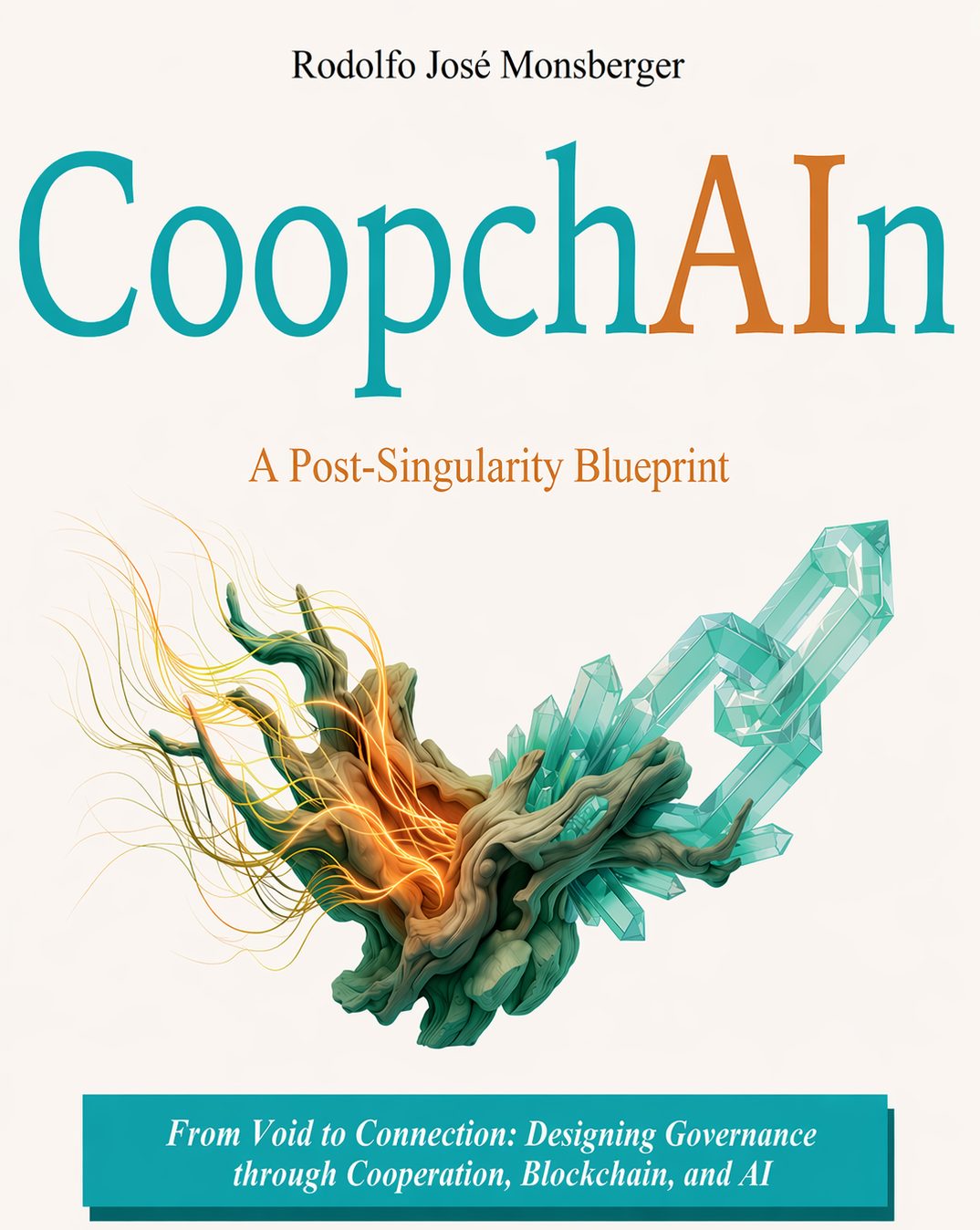
BOOK SUMMARY
By Rodolfo José Monsberger
For decades, we became accustomed to a simple idea: the future would belong to those who were more efficient.
- Faster.
- More productive.
- More automated.
- More scalable.
Companies, governments, banks, universities, and cooperatives learned to repeat the same promise to themselves: if we incorporate more technology, reduce costs, optimize processes, and digitize forms, then we will be ready for what comes next.
But perhaps that promise has already begun to age.
Not because efficiency has stopped mattering. But because it is becoming less scarce.
Artificial intelligence is quietly entering the heart of organizations. It does not merely automate tasks: it is beginning to automate diagnoses, decisions, analysis, responses, designs, calculations, predictions, and conversations. What once required entire teams can now be solved in minutes. What once differentiated an institution may tomorrow become a basic function available to anyone.
Then an uncomfortable question arises:
What remains as an advantage when everyone can be efficient?
The answer does not seem to lie in a new application, another dashboard, or one more technological trend. Perhaps it lies in something much older: the human capacity to trust, coordinate, belong, and cooperate.
That is where the territory of CoopchAIn begins.
Not as a technical explanation of blockchain. Not as a naive celebration of artificial intelligence. Nor as a nostalgic defense of traditional cooperativism. Rather, as a suspicion.
The suspicion that some community-based organizations already contained, without knowing it, a logic that technology is now trying to encode: distributed trust, shared governance, a common ledger, collective identity, and network-generated value.
In other words: perhaps cooperatives understood something before Silicon Valley did.
Perhaps blockchain did not invent decentralization.
Perhaps it simply made it programmable.
And perhaps AI is not only here to replace work.
Perhaps it is forcing us to redefine what we mean by work, value, and community.
The problem is that we keep looking at the future with old maps.
We look at the economy as if it were a machine: parts, gears, performance, friction, productivity. But the real world looks less like a factory and more like a living network: relationships, flows, interdependencies, fragile balances, accumulated trust, and ruptures that spread.
- When a community loses trust, installing software is not enough.
- When an institution loses legitimacy, digitizing processes is not enough.
- When work loses meaning, technical training is not enough.
- When technology concentrates power, admiring its speed is not enough.
Something deeper is moving underneath.
Artificial intelligence accelerates. Blockchain distributes. Cooperativism connects.
But these three forces do not integrate on their own. They can also collide, become distorted, or be captured. AI can concentrate power in the hands of those who control data, infrastructure, and models. Blockchain can become empty speculation if it loses its community dimension. Cooperativism can remain trapped in its own history if it does not dare to redesign its future.
The challenge is not to choose between tradition and technology.
The challenge is more uncomfortable: to design institutions capable of governing technological abundance without losing human depth.
Because the future will not only be a dispute between more or less digital companies. It will be a dispute between ways of organizing trust.
- Who validates?
- Who decides?
- Who participates?
- Who captures the value?
- Who is left out?
- Who governs the algorithms that are beginning to govern our decisions?
These questions do not belong only to technologists. Nor are they exclusive to economists, cooperativists, or regulators. They are civilizational questions. Questions that emerge when a society discovers that its tools are advancing faster than its agreements.
For a long time, we believed that innovation meant replacing the old with the new. But perhaps true innovation means recognizing which ancient principles now need a new infrastructure.
Cooperation is not a moral relic. It is a social technology.
One of the most sophisticated technologies humanity has ever produced.
It allowed us to build villages, create languages, sustain markets, found institutions, survive crises, and project shared futures. Before smart contracts existed, there were community pacts. Before tokens, there were forms of belonging. Before distributed ledgers, there were collective memories. Before algorithmic governance, there was an essential question: how do we decide together without destroying one another in the process?
The difference is that this question now returns at a new scale.
It is no longer only about managing a cooperative, a company, or a local community. It is about understanding what kind of social architecture can survive in an age where intelligence is automated, money is programmed, organizations are tokenized, and trust becomes infrastructure.
That is why CoopchAIn does not propose looking at blockchain as a trend, nor at AI as an inevitable threat. It proposes observing the point where both technologies reveal a deeper tension: the need to redesign our forms of coordination.
- Efficiency can be automated.
- Trust, not so easily.
- Productivity can scale.
- Meaning, not necessarily.
- Processes can be optimized.
- Bonds, however, must be cultivated.
And there appears the question that runs through the book without being exhausted:
What kind of organizations do we need when efficiency is no longer the center of the game?
Perhaps organizations less obsessed with control and more prepared to coordinate.
- Less vertical, but not chaotic.
- More distributed, but not fragmented.
- More technological, but not dehumanized.
- More intelligent, but also more responsible.
The future will not arrive as an orderly conference. It will arrive as real changes do: mixed, contradictory, fascinating, and dangerous. With promises of abundance and risks of concentration. With new opportunities for local communities and new forms of invisible dependency. With cooperatives that could reinvent themselves and corporations that could adopt community language without changing their underlying logic.
That is why understanding technology is not enough.
We must understand the institutional design that contains it.
CoopchAIn moves precisely along that threshold: between the old economy of efficiency and a new economy of coordination; between the organization as a machine and the organization as a living network; between artificial intelligence as concentration and blockchain as a possibility of distribution; between cooperativism as memory and cooperativism as future infrastructure.
The book does not offer a closed recipe.
It opens a conversation.
And perhaps that is its main provocation: to suggest that the future will not be decided only by those who program better algorithms, but by those capable of better governing the bonds those algorithms will transform.
The question, then, is not whether AI and blockchain will change organizations.
The question is another:
Who will design the community rules of that change?
To continue exploring these ideas, dialogue with the book, access complementary materials, or purchase the book, visit: